India’s Tokenised Corporate Bond Journey: MSE, IIFL Finance and Demat 2.0
India’s debt market is entering a new digital era with tokenised corporate bonds. Explore IIFL Finance’s issuance through MSE, SEBI’s Demat 2.0 pilot, CBDC-based settlement, the ₹1,025 crore pilot activity and what tokenisation could mean for the future of India’s bond market.
By IPO Master
India’s Tokenised Corporate Bond Journey
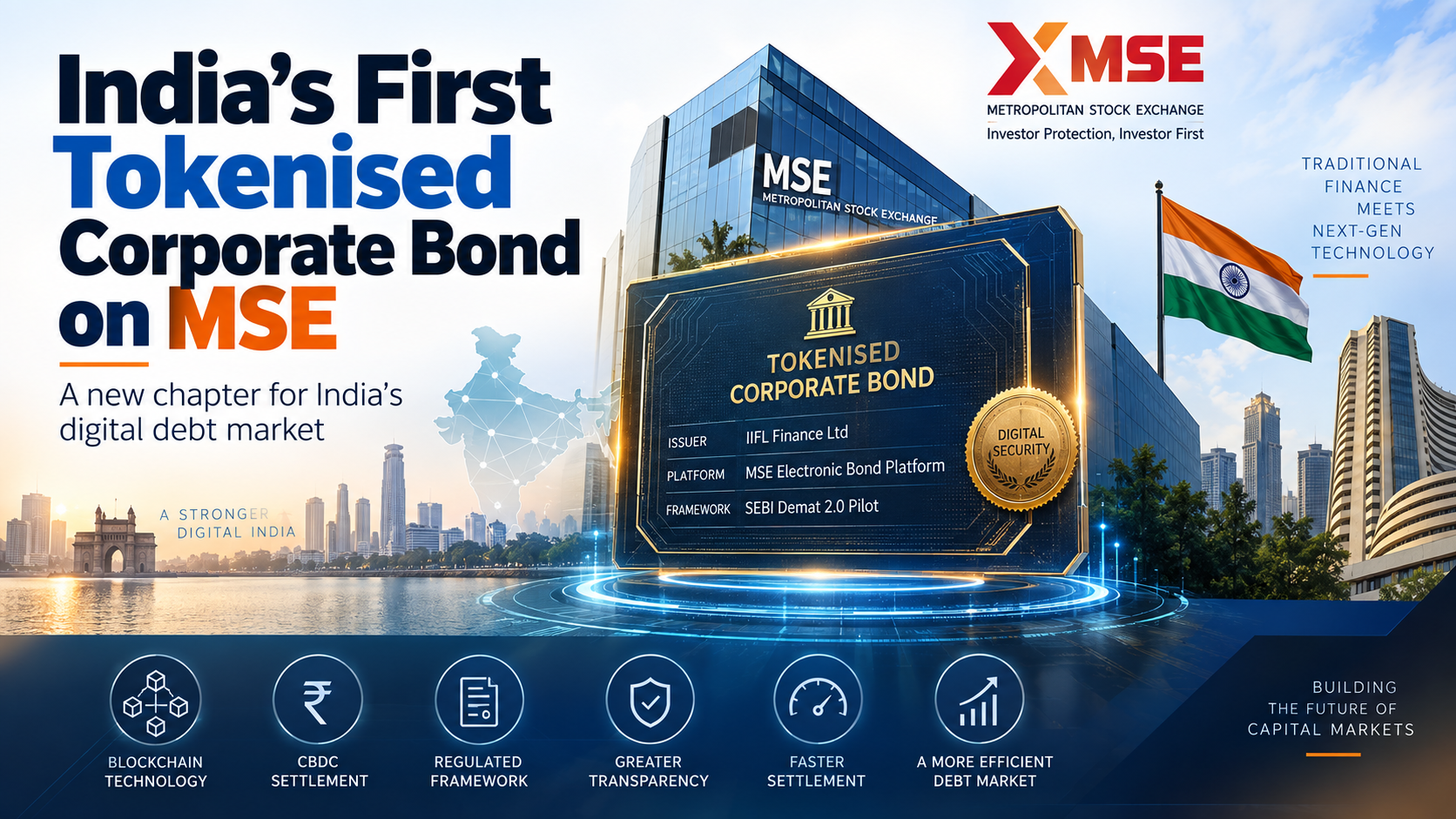
India’s debt market has entered a new phase with the use of distributed ledger technology, tokenisation and central bank digital currency infrastructure. Under SEBI’s Demat 2.0 pilot, the Metropolitan Stock Exchange of India (MSE) has facilitated a tokenised corporate bond issuance by IIFL Finance through its Electronic Bond Platform (MSE EBP), with Trust Investment Advisors as the arranger.
There is an important distinction in how this development should be described. MSE’s transaction represents its first tokenised corporate bond issuance under the pilot. At the country level, REC Limited completed the first tokenised corporate bond issue of the pilot on September 7, 2026. L&T and IIFL Finance followed, bringing the reported pilot issuance to ₹1,025 crore.
What Is a Tokenised Corporate Bond?
A tokenised corporate bond is a debt security represented digitally on a distributed ledger. Instead of relying only on traditional recordkeeping, the security and related transaction data can be handled through digital infrastructure designed to improve efficiency, transparency and settlement.
Tokenisation does not remove the regulated market structure. Under the Demat 2.0 pilot, tokenised securities can remain connected to existing demat and depository infrastructure while using newer technology for issuance and settlement.
IIFL Finance Tokenised Bond on MSE
IIFL Finance issued a tokenised corporate bond through MSE’s Electronic Bond Platform. Trust Investment Advisors acted as the arranger. The transaction was conducted as part of the SEBI Demat 2.0 regulatory sandbox pilot.
The pilot is designed to test how tokenised securities can work with regulated market infrastructure. Reports on the transaction highlight the use of distributed ledger technology for native issuance, statutory depositories for ownership records and CBDC-based settlement.
Why Demat 2.0 Matters
Demat 2.0 is significant because it connects established securities infrastructure with newer digital settlement technology. The objective is not simply to put a bond on a blockchain. The larger goal is to make the full lifecycle of a security more efficient while retaining regulatory oversight.
Potential benefits include faster settlement, improved transparency, reduced operational friction and more efficient capital formation. The pilot also provides regulators and market participants with practical experience before the technology is expanded to a wider group of investors and platforms.
₹1,025 Crore Tested Under the Pilot
The early transactions show that tokenised bonds are moving beyond a technology demonstration. Reports on the SEBI Demat 2.0 pilot indicate that REC Limited, L&T Limited and IIFL Finance have together issued tokenised bonds worth ₹1,025 crore.
REC was reported as the first issuer with a ₹500 crore issue. L&T followed with another ₹500 crore issue, while IIFL Finance completed a ₹25 crore issue. These transactions provide an early test of how institutional debt issuance can operate using tokenised infrastructure.
What Could Change for the Bond Market?
• Faster settlement: Digital settlement rails can reduce processing time and operational dependencies.
• Greater transparency: Distributed ledger infrastructure can provide a consistent digital record of transactions.
• Lower operational friction: Automation can reduce manual reconciliation and processing work.
• Better market infrastructure: Issuers, arrangers, exchanges, depositories and settlement systems can connect through modern digital workflows.
• Potentially wider access: Future phases of the pilot could explore broader investor participation, including retail access.
What About Retail Investors?
Retail participation is one of the most important future questions. The initial pilot activity is focused on institutional and market infrastructure testing. Later phases are expected to explore broader access and additional platforms.
Tokenisation alone does not automatically make a bond suitable for every investor. Liquidity, risk, disclosures, taxation, custody, settlement rules and secondary market trading will remain important considerations.
The Secondary Market Challenge
Primary issuance is only one part of a successful bond market. The bigger long-term test will be secondary market liquidity. Investors need efficient mechanisms to buy and sell securities after issuance.
For tokenised bonds, the market will need clear rules and reliable infrastructure for trading, custody, settlement, accounting and taxation. The success of the technology will ultimately depend on whether it creates a better end-to-end market experience, not simply a new way to issue securities.
A Bigger Opportunity for Financial Technology
For fintech and financial infrastructure companies, tokenised bonds create opportunities across onboarding, KYC, digital signing, investor verification, transaction processing, reporting, compliance and analytics.
The combination of tokenisation, digital identity, electronic documentation, automated workflows and CBDC settlement could create a more connected digital securities ecosystem. This is particularly relevant for institutions looking to reduce manual processes while maintaining compliance and auditability.
What Comes Next?
The next stage will be to evaluate the pilot in real market conditions and determine which parts of the model can scale. Expansion to additional platforms and investor categories will require strong regulatory clarity, dependable technology and sufficient liquidity.
The most important question is no longer whether corporate bonds can be tokenised. The market is now testing whether tokenisation can deliver measurable improvements in speed, transparency, cost and access while working within India’s regulated financial infrastructure.
Conclusion
The IIFL Finance transaction through MSE’s Electronic Bond Platform is an important milestone in India’s Demat 2.0 journey. Along with the earlier REC and L&T transactions, it shows how regulators and market participants are experimenting with a new model for digital debt issuance and settlement.
For India’s financial technology ecosystem, the development could be the beginning of a broader shift toward programmable, transparent and digitally native capital markets. The real impact will become clearer as the pilot expands from controlled issuance to wider participation and secondary market activity.
Source Links
Traders Union
Moneycontrol
MSE India Press Releases
Business Standard
Financial Express
Indian Express
Financial Express
Editorial Note
For accuracy, the phrase “first tokenised corporate bond on MSE” refers to MSE’s milestone. India’s first tokenised corporate bond under the Demat 2.0 pilot was reported as REC Limited’s September 7, 2026 issue. The IIFL Finance transaction represents MSE’s first tokenised corporate bond issuance under the pilot.
Use the list on the right to open the next post.