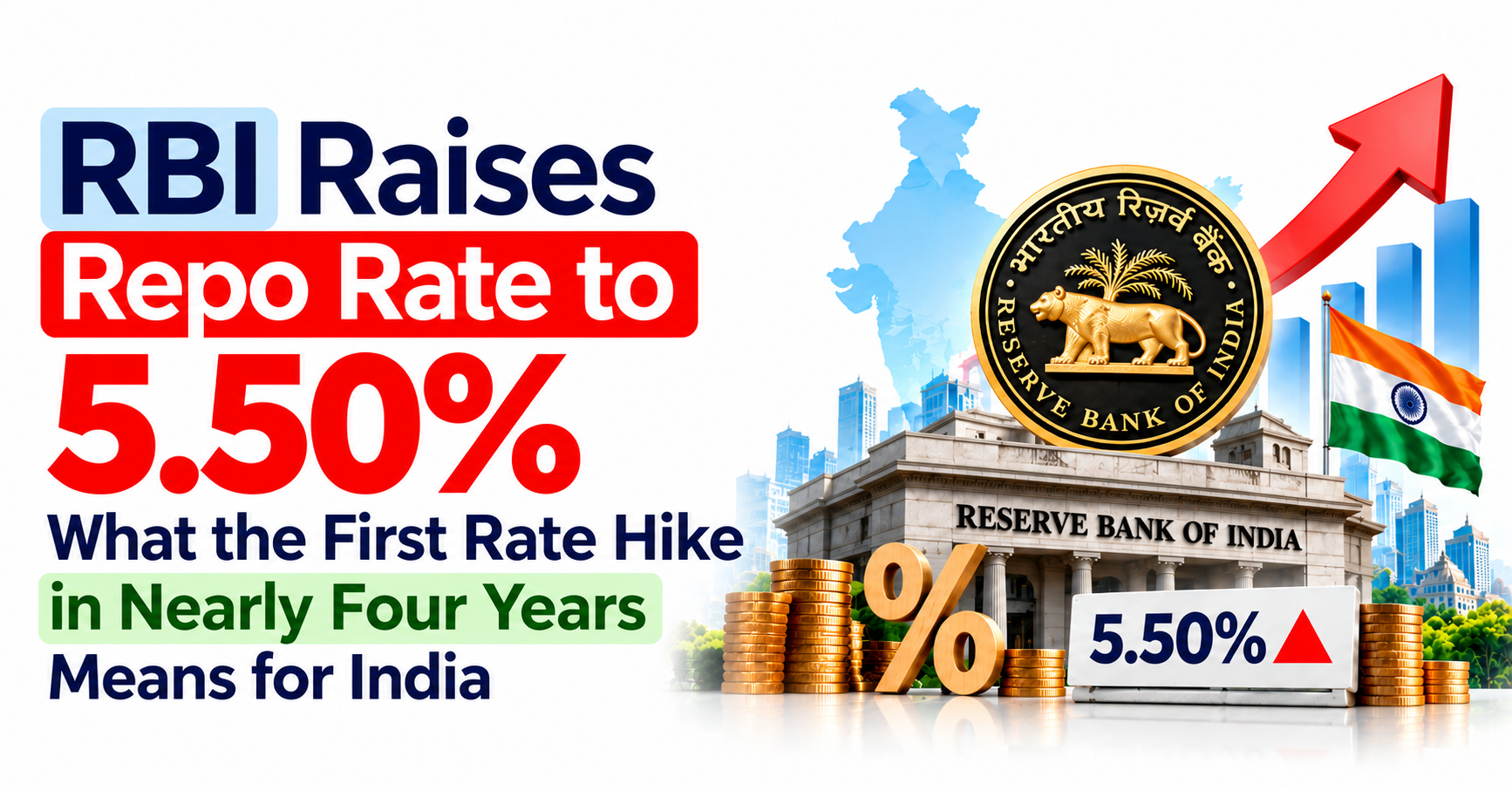
RBI Raises Repo Rate to 5.50%: What the First Rate Hike in Nearly Four Years Means for India
The RBI has raised the repo rate by 25 basis points to 5.50%, its first rate hike in nearly four years. The move comes amid rising inflation and crude oil price concerns, while India's strong economic growth gives the central bank room to focus on price stability.
By IPO Master
write like human like me
RBI Raises Repo Rate to 5.50%: What the First Rate Hike in Nearly Four Years Means for India
The Reserve Bank of India has taken a significant policy step by raising the repo rate by 25 basis points to 5.50%, marking its first rate hike in nearly four years.
The decision was taken unanimously by the six-member Monetary Policy Committee (MPC). More importantly, the RBI has changed its policy stance from “neutral” to “calibrated tightening”, which signals that inflation is becoming a bigger priority for the central bank.
Why Did the RBI Raise Rates?
The rate hike comes at a time when India is facing renewed inflation risks.
Consumer inflation rose to 4.82% in August, moving above the RBI's 4% target for the third consecutive month. At the same time, crude oil prices have moved higher, creating concerns around imported inflation and putting pressure on the rupee.
There is also a global factor at play. Higher oil prices, rising global bond yields and tighter monetary policies in several economies are creating a more challenging environment for emerging markets.
For the RBI, the message is fairly simple: growth is strong, but inflation risks cannot be ignored.
India's Growth Story Remains Strong
What makes this policy decision interesting is that the RBI is raising rates even while the Indian economy continues to grow at a healthy pace.
India's GDP grew 7.8% in the April-June quarter, and the RBI has raised its FY27 GDP growth forecast to 7.1% from 6.7%.
This gives the central bank some room to focus more on inflation without immediately worrying about a sharp slowdown in economic activity.
What Does “Calibrated Tightening” Mean?
This could be one of the most important parts of today's announcement.
The RBI has moved away from a neutral stance and adopted “calibrated tightening.”
It does not automatically mean that another rate hike is guaranteed. Governor Sanjay Malhotra indicated that the timing and extent of any further action will depend on how inflation and economic growth develop.
So, markets will now be watching the upcoming inflation data, crude oil prices, currency movement and global interest rates very closely.
What Could It Mean for Borrowers?
For borrowers, higher interest rates can eventually translate into higher borrowing costs.
Home loans, vehicle loans and personal loans could become more expensive if banks and financial institutions pass on higher funding costs.
On the other hand, depositors could potentially see better returns on certain fixed-income products if deposit rates adjust upward.
The actual impact will depend on how individual banks and lenders transmit the policy change to customers.
What Could It Mean for Banks and NBFCs?
The impact on financial stocks could be mixed.
Higher rates can support lending margins in some situations, but they can also increase borrowing costs and potentially slow credit demand.
This makes loan growth, funding costs, asset quality and net interest margins important indicators to watch in the coming quarters.
India's bank credit growth was already running strongly, with Reuters reporting credit growth of 18.8% in October.
Impact on the Stock Market
For equity markets, the rate hike is important because interest rates influence liquidity, valuations and corporate borrowing costs.
Some interest-rate-sensitive sectors could face pressure if borrowing costs remain elevated, while financial stocks may react differently depending on their funding structure and margins.
Investors will also be watching whether today's policy change marks the beginning of a longer tightening cycle or simply a precautionary move to keep inflation expectations under control.
Oil Prices Remain a Major Risk
One of the biggest challenges for India is crude oil.
India imports a large portion of its energy requirements, so a sustained increase in crude prices can affect:
Inflation
The current account
The rupee
Corporate input costs
Consumer purchasing power
Reuters reported Brent crude above $101.50 a barrel, adding to concerns about imported inflation and external pressures.
This makes the global energy situation an important factor for India's monetary policy outlook.
What Should Markets Watch Next?
After today's rate hike, the focus is likely to shift towards the data.
The key indicators to watch are:
Inflation: Does CPI inflation continue to move higher?
Crude oil: Can energy prices remain elevated?
Rupee: Will currency pressure increase imported inflation?
Economic growth: Does higher borrowing cost affect consumption and investment?
Credit growth: Does loan demand remain strong?
Global rates: How do the US Federal Reserve and other major central banks respond to inflation?
The Bigger Picture
The RBI's latest decision is more than just a 25-basis-point rate hike.
It marks a change in the direction of monetary policy after a long period of easing. At the same time, the RBI is not signalling that growth is in trouble. In fact, the stronger GDP outlook shows that the central bank still sees considerable resilience in the Indian economy.
The challenge now is finding the right balance between controlling inflation and maintaining economic momentum.
For investors and businesses, the next few months could therefore be important. Inflation data, crude prices, liquidity conditions and the RBI's future communication will likely determine whether this remains a one-off adjustment or develops into a broader tightening cycle.
Key Takeaway
The RBI has raised the repo rate to 5.50% for the first time in nearly four years and shifted its stance to calibrated tightening.
The move reflects rising inflation and oil-price risks, while India's strong economic growth gives the RBI some flexibility to focus on price stability.
Use the list on the right to open the next post.