Syngene International: Is the Sharp Stock Correction Creating an Opportunity for Investors?
Syngene International’s share price has corrected sharply from ₹960 to ₹344.45, raising questions about a potential recovery opportunity. Explore the reasons behind the decline, Q2 FY27 financial performance, business challenges and key factors investors should watch before making investment decisions.
By IPO Master
Syngene International: Is the Sharp Stock Correction Creating an Opportunity for Investors?
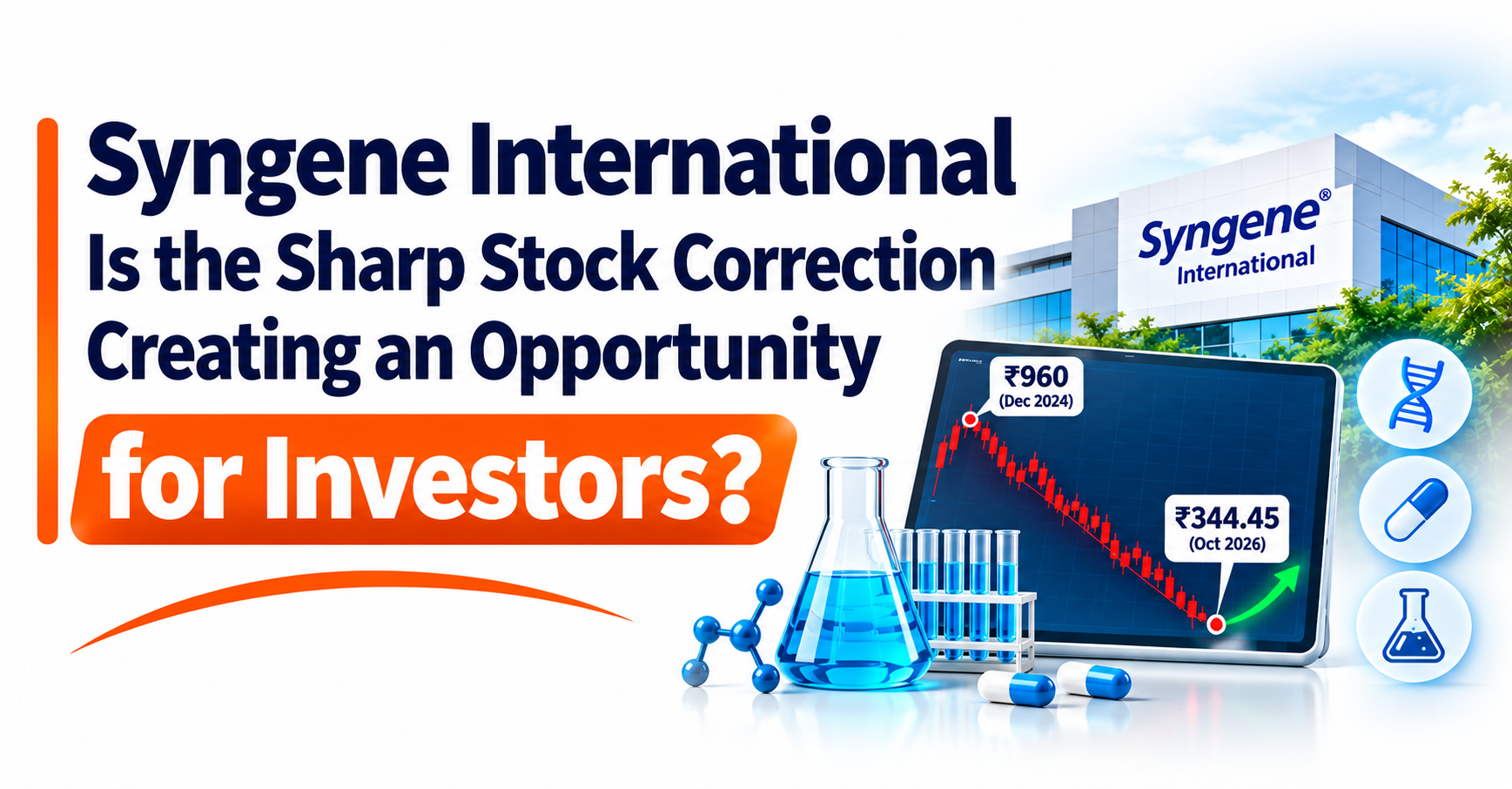
A sharp fall in a stock price often attracts investors looking for potential recovery opportunities. Syngene International is one such company. Its share price declined from an all-time high of around ₹960 in December 2024 to a low of ₹344.45 in October 2026.
However, a lower share price does not automatically mean a stock is undervalued. Investors need to understand what caused the decline, whether the business fundamentals remain strong and what could drive a recovery.
Let's understand Syngene's business, the reasons behind its recent challenges and the factors investors should track going forward.
Understanding Syngene's Business
Syngene International is a contract research, development and manufacturing organisation (CRDMO). In simple terms, it helps pharmaceutical and biotechnology companies discover, develop and manufacture medicines.
Developing a new drug requires specialised scientists, laboratories, testing facilities and significant investment. Pharmaceutical companies can outsource some of this work to organisations like Syngene instead of building all the capabilities themselves.
The company operates through two major business segments:
Research Services: Syngene provides scientific teams and laboratory facilities for drug discovery, testing and early-stage research. This segment has historically been a major contributor to its revenue.
Development and Manufacturing Services (CDMO): The company supports pharmaceutical clients in developing manufacturing processes and producing drug substances. This business offers opportunities to build long-term relationships as drug candidates progress towards commercial production.
Syngene works with global pharmaceutical companies and has built capabilities across small-molecule research, biologics and manufacturing. Its established client relationships and specialised infrastructure are important strengths.
Why Has the Stock Fallen Sharply?
The recent correction reflects multiple business challenges rather than just a change in market sentiment.
1. Loss of the Zoetis Manufacturing Opportunity
One of the biggest setbacks came from Syngene's manufacturing agreement with Zoetis, a global animal health company.
Syngene had a long-term agreement to manufacture the drug substance for Librela, a medicine used to treat osteoarthritis pain in dogs. The contract had the potential to generate up to $500 million over ten years.
However, demand weakened following safety concerns and changes in the product's market outlook. As a result, Zoetis reduced its requirements, and Syngene received no supplies for this customer in the first two quarters of FY27.
This affected revenue and left some manufacturing capacity underutilised. It also highlighted the risk of depending heavily on a large customer or product.
2. Pressure on Research Services
Research Services has traditionally been the foundation of Syngene's business, but this segment has faced slower demand.
Pharmaceutical companies have become more selective about research spending, while competition from other global and Indian service providers has increased.
The growing use of artificial intelligence and automation is also changing drug discovery. Customers increasingly expect faster results and specialised solutions.
For Syngene, the challenge is to move towards higher-value research services and maintain its competitive position.
3. Heavy Investments and Lower Capacity Utilisation
Over the last few years, Syngene invested significantly in expanding its manufacturing capabilities in India and the US.
These investments were made with expectations of higher future demand. However, slower business growth and the Zoetis setback have affected the utilisation of some facilities.
Even when a facility is not operating at full capacity, the company continues to incur depreciation and other operating costs. This puts pressure on margins and return on capital employed (ROCE).
Improving utilisation of existing facilities will therefore be an important part of the recovery.
4. Currency Hedge Losses
Foreign exchange movements have also affected profitability. Syngene reported ₹111 crore of currency hedge losses in the first half of FY27.
These losses added pressure at a time when the company was already dealing with lower business volumes and operating costs.
What Could Drive a Recovery?
Despite the challenges, Syngene is working on several initiatives to improve its business performance.
Expansion of CDMO Operations: The company is looking to increase its contribution from development and manufacturing services. Its first manufacturing agreement for the Bayview facility in the US is a positive development. However, investors should track when this agreement starts contributing meaningful revenue.
Focus on Higher-Value Research: Syngene is investing in automation, AI and specialised research capabilities to improve productivity and offer more valuable services to customers.
Cost Control: The company has undertaken manpower optimisation and is focusing on controlling operating expenses. It is also expected to be more selective with future capital expenditure.
Long-Term Client Relationships: Syngene's established relationships with global pharmaceutical companies remain an important business strength. Its extended partnership with Bristol Myers Squibb provides continuity, although future growth will depend on actual project activity and business volumes.
What Do the Latest Financial Results Indicate?
Syngene's Q2 FY27 results reflect continued year-on-year pressure.
Revenue from operations stood at ₹833 crore, compared with ₹911 crore in Q2 FY26. Operating EBITDA declined to ₹147 crore from ₹200 crore, while profit after tax came in at ₹32 crore against ₹67 crore in the same quarter last year.
There was some improvement compared with the previous quarter. The operating EBITDA margin increased from 12% in Q1 FY27 to around 18% in Q2 FY27.
This sequential improvement is encouraging, but investors should wait for consistent improvement in revenue, profitability and cash generation before concluding that the business has entered a sustained recovery phase.
Key Factors Investors Should Track
For investors studying Syngene, the following developments will be important:
Research Services growth: A recovery in research demand will be important for overall business performance.
CDMO order conversion: New agreements should translate into actual manufacturing revenue.
Capacity utilisation: Better utilisation of existing facilities can improve operating efficiency.
Operating margins: Lower exceptional costs and better cost control should support profitability.
ROCE: Improving returns on capital will indicate whether past investments are generating adequate returns.
Management execution: The new leadership team needs to demonstrate measurable progress on growth and profitability.
EZ Wealth's View
Syngene International operates in an industry with long-term opportunities, supported by pharmaceutical outsourcing, specialised research and the growing need for advanced manufacturing capabilities.
The company has established client relationships and a strong operating presence. However, the current slowdown, lower capacity utilisation and pressure on profitability are genuine concerns.
The sharp correction in the share price may make the company worth tracking, but investors should not consider the fall alone as a reason to invest. A meaningful recovery will depend on stronger business growth, better margins, improved capacity utilisation and higher returns on capital.
At EZ Wealth, we believe investors should focus on the improvement in business fundamentals and valuation rather than simply looking at how much a stock has corrected.
Disclaimer: This article is for educational and informational purposes only and should not be considered a buy or sell recommendation. Investors should conduct their own research and consider their risk profile before making investment decisions.
Use the list on the right to open the next post.